The Continual Evolution of Duke Energy’s Hot Springs Microgrid
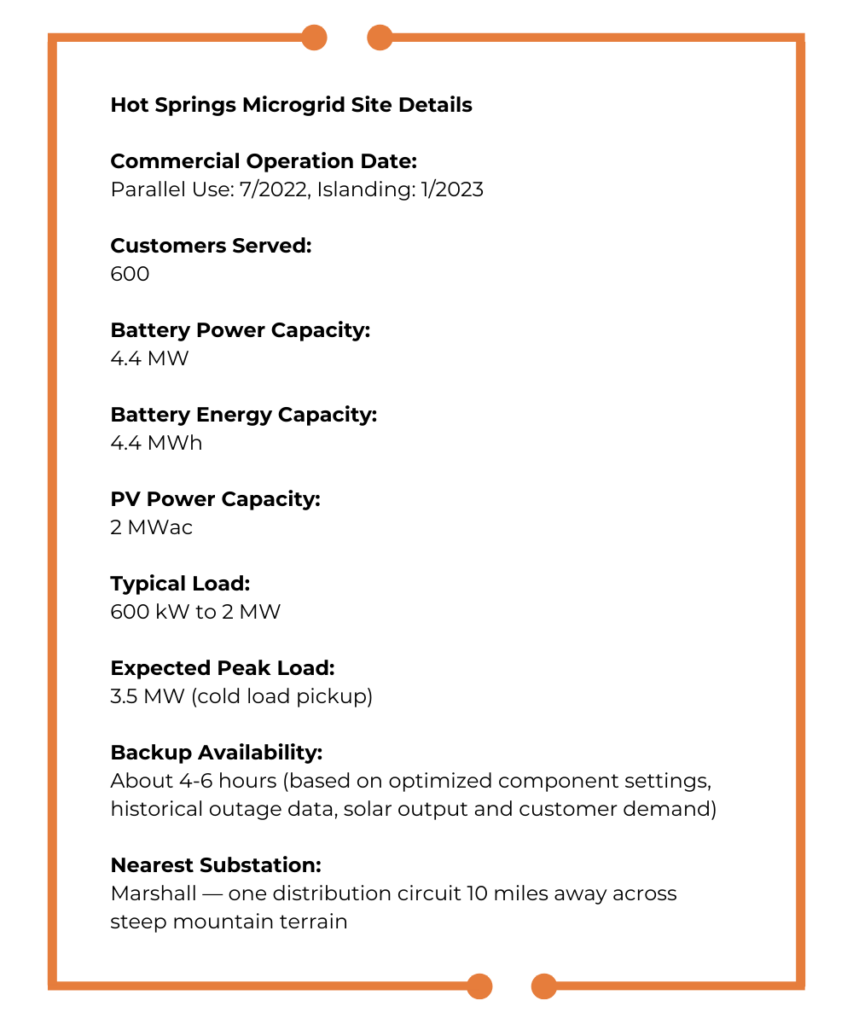
“The power went out and (about 10 minutes) later it came back on,” said Amanda Arnett, co-owner of the Spring Creek Tavern in Hot Springs, North Carolina, after early grid testing of the Hot Springs microgrid in 2023. “The town being able to function is going to be huge for the entire community.”
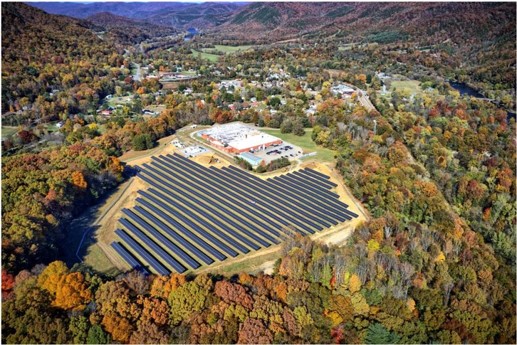
Microgrids are independent power systems that can power a building, campus or small community during an outage. They’ve been used for decades but have been growing in popularity in recent years, especially as an option in more vulnerable locations where a broader network of poles and wires is cost prohibitive. In the remote community of Hot Springs, Duke Energy sought to develop a tool that could provide resiliency when power was lost and energy arbitrage when it was available, with solar and battery resources supporting and stabilizing full grid operation.
The microgrid had a massive test in September 2024 when Hurricane Helene pummeled the Southeast, causing significant damage and power outages to millions of customers. But within days of the storm passing, Hot Springs — which saw its substation wash away — was able to safely start to power back up, thanks in part to the performance of its microgrid.
It took three days for Duke Energy to be able to safely access the system and two more until it was back online and providing power. For the next six days — until a mobile substation was installed — the microgrid kept the entirety of downtown Hot Springs powered.
“We learned a whole lot from seeing the microgrid in action really for the first extended amount of time, and I would say it performed very strong in relation to what it was built to do — we were very pleased,” said Jason Handley, general manager of Duke Energy’s Distributed Energy Group.
Iterative Learnings Build Stronger Systems
Indeed, Duke Energy, and the industry more broadly, is constantly learning from its microgrids and using that knowledge to improve.
In April 2023, for example, a large windstorm took out structures along the power line that feeds Hot Springs. The microgrid islanded (disconnected from the main grid) for the first time in a real-world scenario, providing power for 12 of the 48 total outage hours. However, it didn’t automatically turn on, and Duke Energy had to manually intervene. “It was a successful failure,” Handley said. “We had 18 or 20 different learnings from that first event that helped us get better.”
Hurricane Helene revealed the critical importance of preparation and closely working with the community. Running simulations on protection and control schemes and on faults in different areas — using digital twin functionality — was vital for optimizing field performance. After the storm passed and the microgrid was serving the town, the community was asked to conserve energy to help extend the microgrid’s performance.
Another finding? “The batteries need batteries,” said Handley, referring to the need to charge the battery systems of the uninterruptible power supplies (UPS) when arriving at Hot Springs. These batteries keep communications and controls operating, and Duke Energy is now installing a small generator to power the microgrid’s auxiliary loads. It plans to include this feature in future microgrid designs as well, especially where longer-duration outages may be expected.
A year-plus of operation has further demonstrated that the Hot Springs microgrid can discharge more than initially thought, so Duke Energy is redoing its interconnection agreement to get more use out of the solar resources. Battery performance, too, in terms of state-of-charge needs, is regularly being evaluated.
“It’s been a really valuable learning experience for us, and it’s leading into all our other microgrid projects — all the learnings are getting built back in,” said Handley.
What the Future Holds for Hot Springs and Beyond
“A microgrid isn’t a silver bullet, it’s another tool in the toolbox,” Handley said. But the technology is getting better and better, and more microgrids mean more opportunities to improve designs, studies, interconnection procedures, equipment tolerances and contractual requirements.
Future objectives include getting them to be more scalable and repeatable, automating them as much as possible, and hardening them. “Right now, they’re commercial grade, and we need them to be utility grade,” said Handley.
Another remaining hurdle is effectively quantifying microgrid value. Though cost-benefit tools are constantly evolving, a benefit such as resiliency can be difficult to capture. One approach may be to incorporate more community and societal impacts and social vulnerability indexes, as an outage in one area is not the same as an outage in another.
In Hot Springs, Duke Energy is developing an external dashboard that will allow the town mayor and others to track the status of the microgrid. There is also the potential — though nothing currently planned — to create a demand response program to extend the system’s usefulness.
“We’re trying to ensure that we set the stage with Hot Springs,” said Handley. “It’s been that incubator for us, our proving ground, allowing us to see how the technology performs and how it interacts with the community. It’s been a great steppingstone.”

 All Blog Posts